
Our services
CT Scan
Computed Tomography (CT) is a non-invasive exam that helps diagnose and treat a vast array of medical conditions.
At Apex Radiology we have the latest generation of low dose, multi-slice CT scanners, which allow for high detail imaging in 3D.
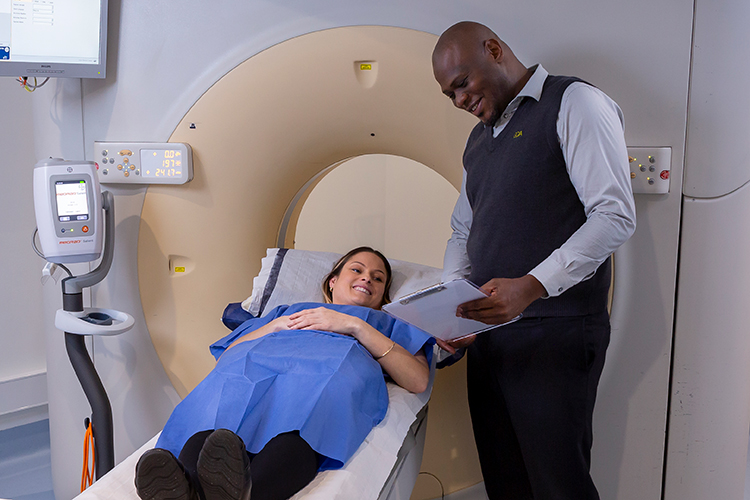
What is a CT Scan?
Computed tomography (CT) is a type of medical imaging that helps doctors diagnose and treat medical conditions.
CT combines x-rays, an array of detectors that rotate around your body, and sophisticated computers to produce detailed cross-sectional and 3D images of your body.
At Apex Radiology we have the latest generation of multi-slice CT scanners, which allow for high detail imaging in 3D.
CT scans of organs, bones, soft tissue and blood vessels provide improved clarity and information as part of a multi disciplinary approach.
CT scans are painless and straightforward. Examination time varies from 5 to 15 minutes depending on your study.
Types of CT Scans done
Apex Radiology uses CT to diagnose a range of conditions by performing tests including:
- Dental Imaging
- Cardiac Imaging
- Coronary Angiograms
- Colonoscopies
- Interventional Pain Management
- Vascular Imaging
- Bone & Joint Imaging
- Chest Imaging
- Abdominal Imaging
- Brain/ Neural Imaging
- Lung Imaging
- Spinal Imaging
- Soft Tissue Imaging
About Your Test
Before your appointment
Patient preparation for CT varies depending on the area of interest.
When you make your appointment, our staff will advise you if you need to fast beforehand.
You should wear comfortable, loose-fitting clothing for your CT scan.
You may be asked to change into a gown before your scan.
Metal objects, such as jewellery, piercings, eyeglasses, dentures, hearing aids or hairpins, may affect the CT images, so you will be asked to remove such items if possible.
Women will be asked to remove bras containing metal underwire.
If you have a pacemaker, please advise a staff member before your scan.
If you are pregnant or think that you might be pregnant, you should advise your referring doctor, as well as the CT radiographer, before your scan. In most cases x-rays should be avoided during pregnancy, but your doctor will weigh-up the risks and benefits.
Please advise our staff before your CT if you:
- Have asthma
- Have impaired or reduced renal function
- Have had a previous allergic reaction to contrast media
- Are taking medication for Type 2 Diabetes
On the day
When you enter the CT room the radiographer will ask you to lie on the table, which will move you through the doughnut-shaped gantry that houses the x-ray tube and array of detectors.
You will hear the movement of the x-ray tube and detectors as they rotate around you to create multiple cross-sectional images of the problem area.
To obtain the clearest image, you will need to keep very still and you may be asked to hold your breath for a few seconds to avoid image blurring.
CT scans are generally painless, relatively fast and straightforward.
The examination time varies, but averages around 15 minutes.
If you require an injection of contrast media, it will be administered at this point via the radiographer or a machine pump. When the contrast is administered, patients often get a metallic taste in their mouth and feel a hot flushing warm sensation throughout the body. Do not be concerned as these sensations are not an allergic reaction and will pass within a couple of minutes.
The radiographer or machine may give you breathing instructions, such as direct you to hold your breath briefly.
After your appointment
After your CT scan is completed, the radiographer will work on the data for some time to prepare the required images for the radiologist and the referring doctor.
The reconstructed images will be interpreted by our radiologist, who will produce a comprehensive report.
Previous imaging will be compared if available to the radiologist.
The results of your scan will be sent directly to your referring doctor, and it is important you book a timely follow-up appointment to discuss your results.
Frequently Asked Questions
Our reception staff will advise you at the time of booking of the exact requirements, depending on your procedure.
If you are having CT of the abdomen, pelvis, chest or head, you should not eat for four (4) hours prior to your appointment, but keep well hydrated by drinking fluids.
If you are having CT of the lumbar spine or sinuses, no preparation is required.
For abdominal and pelvic CT, you may be required to drink water or oral contrast, which highlights the bowel, one (1) hour before your scan. Our booking staff will incorporate this into your appointment time, if needed.
The images obtained during the examination are provided to one of our radiologists who interprets these and provides a written report to your doctor or healthcare provider.
You will be asked to fill in a questionnaire upon arrival. In some instances, you will also need to change into a gown. You will be asked to lie on the table and our radiographer will position you for the scan. The radiographer then moves into the next room to a control console, but they can talk and listen to you via a microphone and can see the whole procedure through a window.
Sometimes you will need an injection of a special dye (called contrast) which helps the radiologist to visualise vessels and internal organs in certain cases. The radiographer performing the examination will go through the steps with you before the scan. Please tell the staff if you have had any form of reaction to the contrast before.
Prior to your scan and to ensure optimal imaging, you may be asked to change into a gown.
A change cubicle will be provided to ensure your privacy and you will be asked to bring your belongings will you, carry baskets are provided.
You will be asked to place your belongings in a suitable location within the room for the duration of your scan.
After your scan, you will be provided with a change cubicle to ensure your privacy.
Please ensure you have all your belongings with you prior to leaving the department.
If you accidentally leave anything behind, please contact our staff to advise and we will endeavour to locate your belongings and return them to you.
Our friendly reception staff will advise you on the cost of your procedure at the time of your booking.
Patient Safety
As CT uses X-rays to recreate the pictures, our staff are highly trained to use the lowest radiation dose possible for high quality images, minimalizing radiation exposure and decreasing risks involved. The radiographer will only scan the area/s of concern, avoiding unnecessary exposure. The benefits of an X-ray generally out outweigh the risks involved.
Pregnant patients should avoid having a CT scan, in order to avoid exposing the fetus to unnecessary radiation.
There are very limited contra indications for CT, meaning almost anyone is eligible to have a CT scan. However, like anything that you introduce to the body there is a risk of allergy involved. Although rare there are some people that might be allergic to the contrast media.
The results of your scan will be sent directly to your referring Doctor, and it is very important you book a timely follow-up appointment to discuss your results.