
Our services
Cardiac Imaging
With the help of cardiac imaging, which plays a vital role in diagnosing and managing coronary heart disease, the leading cause of death in Australia, we can better understand the gradual buildup of fatty deposits on the inner walls of the coronary arteries.
What is Cardiac Imaging?
Cardiac imaging tests are used to screen for heart disease. They can determine what is causing your symptoms, guide treatment planning and find out if your treatment is working.
Based on your symptoms, we provide a range of cardiac imaging services to most accurately assess and diagnose heart conditions.
Types of Cardiac Imaging
Cardiac imaging uses medical imaging technology to search for abnormalities.
At Apex Radiology we undertake a range of cardiac imaging:
Apex Radiology offers a cutting-edge CT Coronary Angiography (CTCA) using advanced CT technology.
This non-invasive test captures high-resolution, 3D images of your moving heart and great vessels, providing accurate diagnosis for coronary artery disease and other cardiac abnormalities.
At Apex Radiology, we use the latest technology CT scanners, which produces the fast, high-resolution images needed for CTCA.
Our radiologists have specialist accreditation awarded by the Conjoint Committee for the Recognition of Training in CT Coronary Angiography.
Before Your Scan
For CTCA, it is preferred that patients have slow and regular heart beat of 65 beats per minute or less.
If the heart rate at the time of scan is more than 65 bpm, the images obtained may have substantial motion artefact.
Patients with a resting heart rate greater than 65 bpm need to take medication to slow the heartbeat, prior to study. You will be given a suitable beta-blocking medication if this medication is needed on the day of the scan.
During Your Scan
The radiographer or nurse will explain the procedure to you and give you the opportunity to ask any questions you may have.
You may be asked to read and sign a consent form that gives your permission for the test. Read the form carefully and ask questions if you don’t understand.
You will be asked to remove any jewellery, or clothing with metal clips, zips or buttons as these show up on CT.
You will be connected to a special heart monitor so that we can observe your heart motion during the scan.
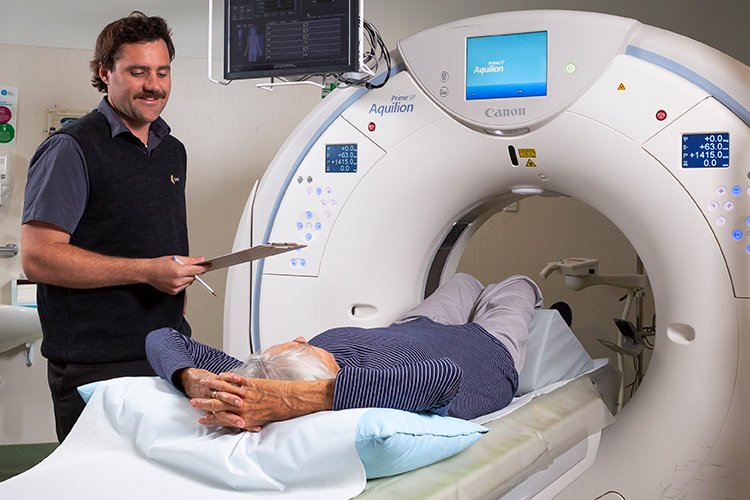
You will lie on the CT table in a position that enables optimal visualisation of the area of interest.
Patients must lie as still as possible during the entire procedure, because any movement could blur the images. You may be asked to hold your breath briefly at intervals when the images are taken.
The length of the examination varies but you should expect to be with us for at least 30 minutes.
While CTCA is not painful, you will need an injection of a small dose of x-ray contrast through an arm vein. After the contrast agent is injected, you may feel flushed, or experience a metallic taste in your mouth.
Please advise our staff before your CT if you:
- Have asthma
- Have had a previous allergic reaction to contrast media
- Are taking medication for Type 2 Diabetes
- Have impaired or reduced renal function
At Apex Radiology, we perform coronary artery calcium scoring, at no additional charge, prior to CTCA to determine whether the coronary arteries are heavily calcified. The radiologist will review your CACS to ensure CTCA will be of value.
After Your Scan
Generally, you can resume usual activities and normal diet immediately after the CTCA.
One of our specially trained radiologists will interpret the CTCA and provide your doctor with a comprehensive report.
You will need to return to the doctor who referred you to discuss your CTCA results.
Processing and reporting of your CTCA could take up to one week.
Coronary artery calcium scoring (CACS) is a non-invasive test that estimates the amount of coronary artery plaque, by assessing the extent of coronary artery calcification using high-resolution CT scan.
While a calcium score of ‘zero’ does not rule out disease, there is a low likelihood of significant coronary blockage.
A high calcium score correlates with a moderate to high risk of a coronary event, or heart attack, within two to five years.
Before Your Scan
Medicare does not provide patients with a rebate for CACS therefore any requests for Calcium Scores scans will be charged a private fee. Patients having a CACS during a CTCA will not be charged extra.
There is no specific patient preparation for CACS.
Patients are required to have a stable and/or low heart rate for this scan, if the heart rate is outwith the required rate, you may be given a medication to assist and therefore will be asked to stay in the department for 30mins prior to your scan and 30mins after.
During Your Scan
No x-ray contrast is injected during this test.
Our staff will ensure that all patients receive minimal radiation dose during an examination. The dose for CACS varies depending on factors such as patient size and body shape, but is relatively low.
After Your Scan
A calcium score scan is very quick and easy if you have a steady heart rate, there will be no need to stay in the department after your scan if you haven’t been given any medication for your heart rate.
Generally results will not be available immediately.
A Pharmaceutical Stress Myocardial Perfusion Scan examines the blood supply (perfusion) to the heart muscle using a gamma camera.
The blood supply is made visible to the camera by the introduction of a small amount of radioactive tracer, (radiopharmaceutical or MIBI) injected into an arm vein.
The injection is given during stress, then again while resting later on.
The heart is subjected to a stress test using a pharmaceutical called persantin, as an alternative to exercising.
After each injection, a gamma camera placed over the chest images (maps) the pattern of tracer accumulated in the heart’s left ventricle, giving information useful in diagnosing and managing conditions such as coronary artery disease, infarcts and diseases of the heart muscle (cardiomyopathy).
Before Your Scan
What to bring
- Your referral form
- Any relevant previous imaging
- Your Medicare card and any concession cards
- All of your current medications in their containers
Preparation
A referral from your doctor or medical specialist, and an appointment is required for this examination.
Before you attend your appointment please read and follow exactly the printed instructions that will be given to you when making your appointment.
During the 24 hours before your appointment time:
- Do not drink any tea, coffee; chocolate or cola drinks (even small amounts).
- Do not eat anything containing caffeine (even small amounts).
- Do not eat chocolate.
- Do eat a light breakfast on the day of your appointment.
- Advise us before the appointment if you are diabetic and follow the printed instructions for diabetics.
- Check the list of medications which may interfere with the test and cease any of these if you have been instructed to do so by your referring doctor or medical specialist.
- Wear loose, comfortable clothes for the stress test.
Please call Apex Radiology immediately for clarification if you have any further questions.
If you are pregnant, breastfeeding, or caring for a small child on the appointment day, please notify us in advance to receive special instructions.
During Your Scan
When you attend your appointment at Apex Radiology you will be asked to answer a few safety questions, remove any jewellery, watches etc.
A nurse will explain and prepare you for the stress test, which includes introducing an intravenous cannula (a small tube for taking blood samples and administering medicines) and electrocardiogram (ECG) monitoring during the persantin (MIBI) infusion.
A doctor will then speak to you, explain what you are likely to feel, and begin the stress test.
Near the end of the stress test, the doctor will inject the MIBI through the intravenous cannula.
After 30 to 60 minutes resting, the technologist will position you in the gamma camera and begin imaging.
The gamma camera is a large square radiation detector which rotates around the chest (SPECT).
You will experience no unusual sensations or discomfort from the scan which takes around 15 minutes.
The images are usually combined with a low dose CT (Computed Tomography) scan performed at the same time on the same scanner. This combined SPECT/CT scan improves the accuracy of the information obtained, and adds only a few minutes to the duration of the procedure.
After the first scan is completed, the technologist will inject more MIBI, and ask you to wait, resting from 30 to 60 minutes before repeating the scan to show the heart perfusion at rest.
Please allow between two to four hours for the entire procedure.
After Your Scan
The radioactive tracer will decay over time and the body will eliminate any residue through the kidneys and bowel and you are free to resume normal activities.
You should drink plenty of water after the scan to help the elimination process.
If you are caring for a small child, or breastfeeding, we may ask you to take some minor precautions.
An Exercise Stress Myocardial Perfusion Scan examines the blood supply (perfusion) to the heart muscle using a gamma camera.
The blood supply is made visible to the camera by the introduction of a small amount of radiopharmaceutical injected into an arm vein.
The injection is given to you at rest and then again during stress exercise on a treadmill.
After each injection, a gamma camera placed over the chest takes images (maps) the pattern of tracer accumulated in the heart’s left ventricle, giving information useful in diagnosing and managing conditions such as coronary artery disease, infarcts and diseases of the heart musclecardiomyopathy.
Before Your Scan
What to bring
- Your referral form
- Any relevant previous imaging
- Your Medicare card and any concession cards
- All of your current medications in their containers
Preparation
A referral from your doctor or medical specialist, and an appointment is required for this examination.
Before you attend your appointment, please read and follow the printed instructions exactly.
During the 24 hours before your appointment time:
- Do not drink any tea, coffee, chocolate or cola drinks (even small amounts).
- Do not eat anything containing caffeine (even small amounts).
- Do not eat chocolate.
- Do eat a light breakfast on the day of your appointment.
- Advise us before the appointment if you are diabetic and follow the printed instructions for diabetics.
- Check the list of medications which may interfere with the test and cease any of these if you have been instructed to do so by your referring doctor or medical specialist.
- If you are pregnant, breastfeeding, or caring for a small child on the appointment day, please notify us in advance to receive special instructions.
- Wear loose, comfortable clothes and suitable footwear for the stress test
Please call Apex Radiology immediately if you have any further questions or need any clarification.
During Your Scan
When you attend your appointment at Apex Radiology you will be asked to answer a few safety questions, remove any necklaces.
A nurse will explain and prepare you for the stress test, which includes introducing an intravenous cannula (a small tube for taking blood samples and administering medicines) and electrocardiogram (ECG) monitoring during the treadmill exercise.
A doctor will then speak to you before you start the exercise process. If exercise presents problems for you the doctor may suggest either trying gently exercising on the treadmill or an alternative stress method using a pharmaceutical.
For the test to give useful results it is important to stress the heart sufficiently, so the exercise will increase in intensity for as long as needed.
Near the end of the exercise, the doctor will inject the tracer through the intravenous cannula.
After 20 to 60 minutes resting, the technologist will position you in the gamma camera and begin imaging. The gamma camera is a large square radiation detector which rotates around the chest (SPECT). There are no unusual sensations or discomfort, and the scan takes 15 minutes.
The images are usually combined with a low dose CT scan done at the same time on the same scanner. This SPECT/CT improves the accuracy of the information, and adds a few minutes to the procedure time.
After the first scan, the technologist will inject more MIBI, and ask you to wait, resting from 30 to 60 minutes before repeating the scan to show the heart perfusion at rest.
Please allow up to four to six hours for the complete procedure.
After Your Scan
Little of the radioactive tracer remains in the body after a renal scan, most of the radiotracer is excreted through the kidneys and bladder.
You can resume your normal activities immediately after the procedure is completed.
You should drink plenty of water after the scan to help the elimination process.
If you are caring for a small child, or breastfeeding, we may ask you to take some minor precautions.
Frequently Asked Questions
There is no preparation needed for this test.
There are different risks associated with various cardiac imaging examinations. These risks will be explained to you by the Cardiologist before your examination begins.
Depending on the body part being examined, you may be required to wear a provided gown. We also request removal of jewellery and body piercing items which may be in the field of view. This makes interpretation of the images more accurate. Our friendly radiography team will clearly explain what you have to do during the appointment and will guide you through the process.
Prior to your scan and to ensure optimal imaging, you may be asked to change into a gown. A change cubicle will be provided to ensure your privacy and you will be asked to bring your belongings will you, carry baskets are provided. You will be asked to place your belongings in a suitable location within the room for the duration of your scan. After your scan, you will be provided with a change cubicle to ensure your privacy. Please ensure you have all your belongings with you prior to leaving the department. If you accidentally leave anything behind, please contact our staff to advise and we will endeavour to locate your belongings and return them to you.
The time taken depends on the type of cardiac imaging you are having done. Our team will be able to answer this question when you book.
Your images and report are provided through a secure online system to your doctor or healthcare provider. We will also provide you with a printed copy to bring to your next appointment.
Our friendly reception staff will advise you on the cost of your procedure at the time of your booking. If your exam is Medicare eligible, you will be bulk billed.