
Our services
MRI
Magnetic Resonance Imaging (MRI) uses an exceptionally strong magnet, radio frequency waves and a sophisticated computer to generate detailed high-quality images about structures and processes within your body.
MRI provides helpful information to your doctor which aids the diagnose your condition and plan your treatment options.
What is an MRI?
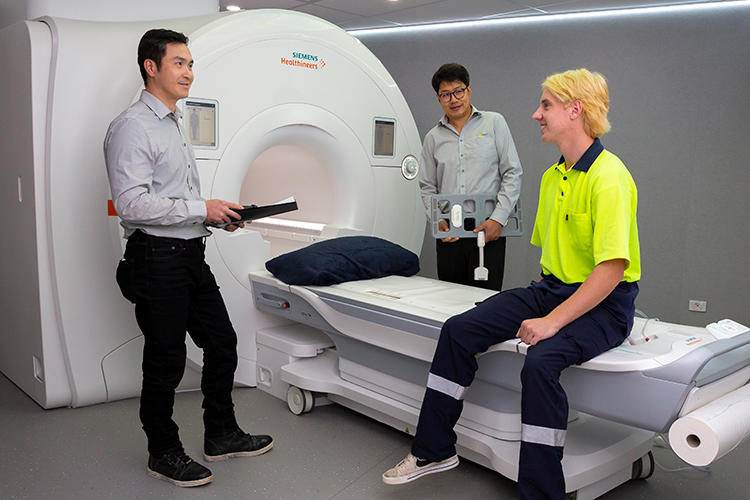
Magnetic Resonance Imaging (MRI) uses an exceptionally strong magnet, radio frequency waves and a sophisticated computer to generate detailed grayscale images without-rays or ionising radiation.
The body or body part is placed within a magnet coil that detects shifting signals, which are encoded by the magnetic field gradients.
Powerful computers then process the signal to form images of the area of interest.
These high-quality images provide information to your doctor about structures and processes within your body. This helps your doctor diagnose your condition and plan your treatment options.
About Your Test
Before your appointment
Please bring the MRI Request form given to you by your doctor.
Avoid wearing any jewellery or metallic objects – if you have piercings within the area to be scanned please remove.
Please avoid wearing make-up if you require a scan of your head or neck.
You may be asked to change into an examination gown prior to scan.
The magnetic field can erase credit cards, electronic devices and immobilisers. You will be asked to remove all of these objects which will be stored securely for the duration of the scan.
Because a strong magnet is used, patients with cardiac pacemakers, metal heart valves, some ear implants, certain brain aneurysm clips and various other medically implanted devices or prostheses may not be able to undergo an MRI procedure.
When booking your appointment you will be asked to answer a series of safety questions to assess your suitability got MRI.
People with metallic foreign bodies in their eyes, through grinding or welding, may be excluded from MRI. An X-ray of the eyes may be required to clear the eyes of any metal fragments.
Patients having a scan of the abdomen or pelvis may need to fast before the appointment, in order to avoid bowel and stomach movement. Our staff will advise if a patient needs to fast, and for how long, when the booking is made.
Patients who suffer from claustrophobia should advise our staff prior to booking an appointment if they’re claustrophobic, so we can discuss options.
On the day
The body region of interest is also placed within a device called a ‘receiver coil’.
Throughout the scan, the radiographer will maintain visual and voice contact with the patient.
The switching of the magnetic gradients creates a loud thumping sound, so the patient will be given hearing protection, which must be worn during the scan.
You will also be able to select the music you’d like to listen to during your scan.
You will be required to remain motionless for the entirety of the scan to obtain high-quality images. If you believe this could be a concern please notify our friendly booking staff when you make your appointment.
Once you are positioned as comfortably as possible on the MRI scanning bed it’s important you remain still for the duration of the scan – typically 15-40 minutes. If you feel claustrophobic or uncomfortable please let the radiographer know.
Sometimes, a small dose of a gadolinium-based contrast is injected through a vein in your arm to temporarily alter the magnetic properties of the body tissue and enhance anatomical detail. Our radiologist will determine whether an injection is required at the time of the scan.
After your appointment
MRI is painless and you will not feel any after effects, you can resume normal activity straight away.
One of our radiologists will interpret the scan and provide your referring doctor with a comprehensive report about the findings.
The results of your scan will be sent directly to your referring doctor, and it is very important you book a timely follow-up appointment to discuss your results.
Frequently Asked Questions
Prior to the MRI scan you will be required to complete a safety questionnaire. You will be asked to double check this information on your arrival for your MRI procedure. Fasting (going without food and fluids) or a special preparatory diet for a MRI procedure might be required in some cases. When you make your appointment, you will be advised of any fasting requirements. If you have a pacemaker or other implants, it is important to tell the radiology practice before having the scan.
It is helpful if you do not wear any makeup or hairspray when you attend your MRI appointment. These products can contain small metal particles that can interfere and reduce the quality of the MRI images. We also recommend leaving valuable items such as watches, wallets and jewellery at home and that you dress in items that do not have metallic components (zips, eyelets, clips, under-wires and hooks).
If you are pregnant, please discuss this with your doctor and tell the radiology practice before having the scan.
If you are claustrophobic (a fear of small or enclosed spaces) and think you might not be able to proceed with the scan, advise your doctor or the MRI facility when making your appointment. Sedative (calming) medication may need to be obtained from your doctor and taken prior to your MRI procedure. If you do need a sedative, you will need to arrange someone else to drive you home.
Please bring any previous medical imaging examinations that relate to your current condition to your MRI appointment.
The MRI procedure will be thoroughly explained to you, and your safety questionnaire reviewed and discussed before you enter the MRI scan room. You will usually be asked to change into a gown. You will be asked to lie on the scan table and given a buzzer to hold. When you squeeze it, an alarm sounds in the control room and you will be able to talk to the MRI technologist.
You will not feel the magnetic field or radio waves, so the procedure itself is painless. However, there may be a lot of loud thumping or tapping noises during the scan so we can offer headphones, music or earplugs to help block the sound.
If you are claustrophobic and find you are unable to proceed with the scan you can alert the MRI technologist straight away. The radiology facility has special procedures for people with claustrophobia and will advise you of what to do if this applies to you. MRI images are very susceptible to movement, so it is important that you are comfortable enough to lie still and hold your position during the scan.
Prior to your scan and to ensure optimal imaging, you will be asked to change into a gown. A change cubicle will be provided to ensure your privacy. As the machine being used for this scan contains a magnet, you will be asked to remove all metal items, such as hair clips, jewellery, hearing aids, dentures. A lockable cupboard will be provided for you to securely store all your belongings for the duration of your scan. After your scan, you will be provided with a change cubicle to ensure your privacy. Please ensure you have all your belongings with you prior to leaving the department. If you accidentally leave anything behind, please contact our staff to advise and we will endeavour to locate your belongings and return them to you.
The scan can take between 15 minutes to over 60 minutes to complete. This depends on the part of the body being imaged and what type of MRI is required to show the information. Before the scan begins, the radiographer will tell you how long the scan takes, so you know what to expect.
The images obtained during the examination are provided to one of our radiologists who interprets these and provides a written report to your doctor or health care provider.
Our friendly reception staff will advise you on the cost of your procedure at the time of your booking.
Patient Safety
No X-rays or ionising radiation is used during an MRI. The magnetic field and radiofrequency waves have not been shown to cause any long-term effects.
Patients with cardiac pacemakers, metal heart valves, some ear implants, certain brain aneurysm clips and various other medically implanted devices may not be able to have an MRI because the metal or electronics will respond to the strong magnetic field.
We may require further information on certain devices to determine their compatibility in the MRI environment.
People with metallic foreign bodies in their eyes, through grinding or welding, may be excluded from MRI. An x-ray of the eyes may be required to clear the eyes of any metal fragments.